
Microfiber vs. Traditional Mop Heads
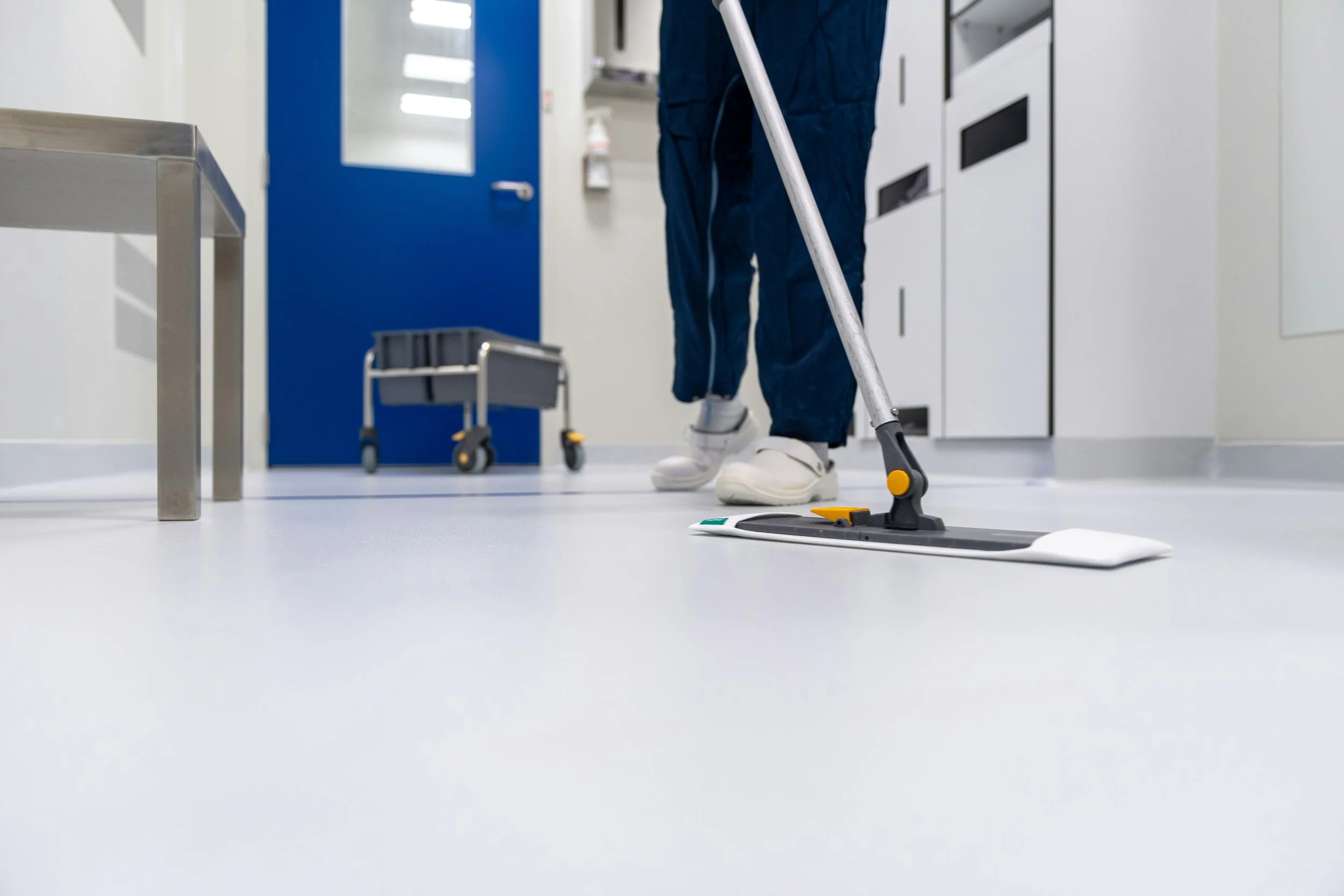
Every facilities manager eventually asks the same question: is it worth switching the custodial closet over to microfiber, or is a traditional string mop good enough? The debate between microfiber vs. traditional mop heads isn’t just preference — infection control researchers have measured the difference, and it has real implications for healthcare facilities, schools, and manufacturing plants across Tennessee, Mississippi, and the Southeast. Here’s what the research shows, and how to turn it into a purchasing decision.
What the Research Actually Shows
The most frequently cited research here comes from Dr. William Rutala and colleagues, whose microbiologic evaluation of microfiber mops found that microfiber — with fiber diameters as fine as 0.37 micrometers — removed up to 98 percent of bacteria and 93 percent of viruses from a test surface using only water. Traditional cotton string mops, by comparison, removed roughly 30 percent of bacteria and 23 percent of viruses under the same conditions. Other published comparisons found similar gaps, with one study reporting 95 percent bacterial removal for microfiber versus 68 percent for cotton, even without disinfectant in the water.
The takeaway isn’t that water alone replaces disinfectant protocols — it’s that the mop material itself does a better job of physically lifting and trapping soil and microorganisms rather than pushing them around the floor, which is what cotton string fibers tend to do.
Why Microfiber Performs Differently
Microfiber’s advantage comes down to structure. Its ultra-fine, split fibers create far more surface area and capillary action than cotton, so it absorbs and holds dirt and moisture rather than smearing them across the floor. Industry comparisons put microfiber’s water absorption at more than five times that of a typical cotton mop, and note microfiber cloths can withstand roughly 350 wash-and-reuse cycles before needing replacement — a durability edge that factors into total cost of ownership even though the upfront price per mop head is often higher.
The Catch: Laundering Matters as Much as Material
Microfiber isn’t magic if it isn’t cared for properly. A widely referenced study of Arizona hospitals found 35 percent of newly laundered microfiber flat mops from 11 facilities were still contaminated with microbes, and 27 percent tested positive for pathogens — a reminder that laundering protocols, water temperature, and detergent selection matter as much as the fiber itself. Facilities that skip proper laundering can lose most of microfiber’s advantage over cotton.
This is one reason the CDC has noted a preference for microfiber in environmental cleaning and disinfection protocols, alongside guidance on correct laundering and color-coding to prevent cross-contamination between zones.
Making the Switch: What to Consider
For healthcare facilities, schools, and food and beverage plants where surface contamination has real consequences, the data makes a strong case for microfiber flat mop systems over string mops. For lower-risk areas — a warehouse floor or break room — cost may matter more than the bacterial removal gap. A reasonable approach: prioritize microfiber in patient care areas, restrooms, and food prep zones first, then expand as budget allows. A distributor who can walk through vendor-managed inventory (VMI) options can also offset microfiber’s higher per-unit cost by preventing overstock and rush orders.
Frequently Asked Questions
Is microfiber really more effective than cotton mops at removing bacteria?
Published research, including work by Dr. William Rutala and colleagues, has found microfiber mops remove significantly more bacteria and viruses than cotton string mops under comparable conditions — in some studies removing over 90 percent of bacteria with water alone, compared to roughly a third for cotton.
Do microfiber mops still need disinfectant?
Yes. While microfiber performs well with water alone in controlled studies, most healthcare and facility protocols still call for disinfectants to meet regulatory and infection-control standards, especially in patient care and food-handling areas.
How many times can a microfiber mop head be washed and reused?
Industry data suggests microfiber cloths and mop heads can generally withstand around 350 wash cycles before performance degrades, though this varies by manufacturer and laundering conditions.
Can microfiber mops become contaminated if not laundered properly?
Yes. A hospital study in Arizona found more than a third of newly laundered microfiber mops were still contaminated with microbes, underscoring that laundering protocol — not just the fiber itself — determines whether microfiber delivers its full infection-control benefit.
Is microfiber worth the higher upfront cost for a small facility?
It depends on the risk level of the space. High-risk areas like patient rooms, restrooms, and food prep zones tend to justify the cost quickly through better contamination control, while lower-risk storage or common areas may not need the switch right away.
Whether you’re outfitting a hospital, a school district, or a manufacturing facility, the right mop system depends on your risk areas, staffing, and laundering capabilities. Contact A-1 Chemical to talk through a microfiber transition plan and janitorial supply program built for your facility.